How to stop enemy bombers? More guns!
By the mid-1930s, the Royal Air Force faced a serious challenge. Enemy forces were developing fast all-metal bombers, and the speed of aerial combat was rising rapidly.
Pilots had only a few seconds to catch opposing aircraft in their gun sights. And in that time, they needed to deliver maximum firepower in a short burst.
The Air Ministry recognised this as early as 1934 and began looking at new fighters with greater hitting power. What started as a demand for a four-gun fighter would evolve into a story of the delicate interplay between Spitfire armaments and wing design.
The birth of the Spitfire Mk I
The initial specifications issued by the Operational Requirements section of the Air Ministry called for an aircraft armed with just four guns.
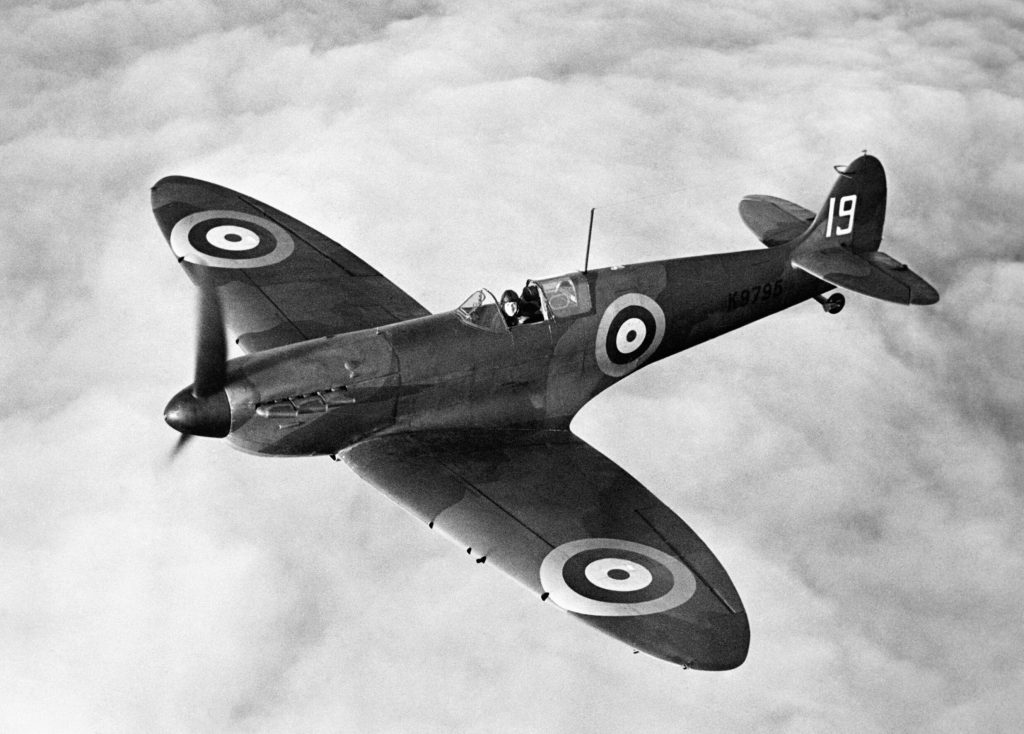
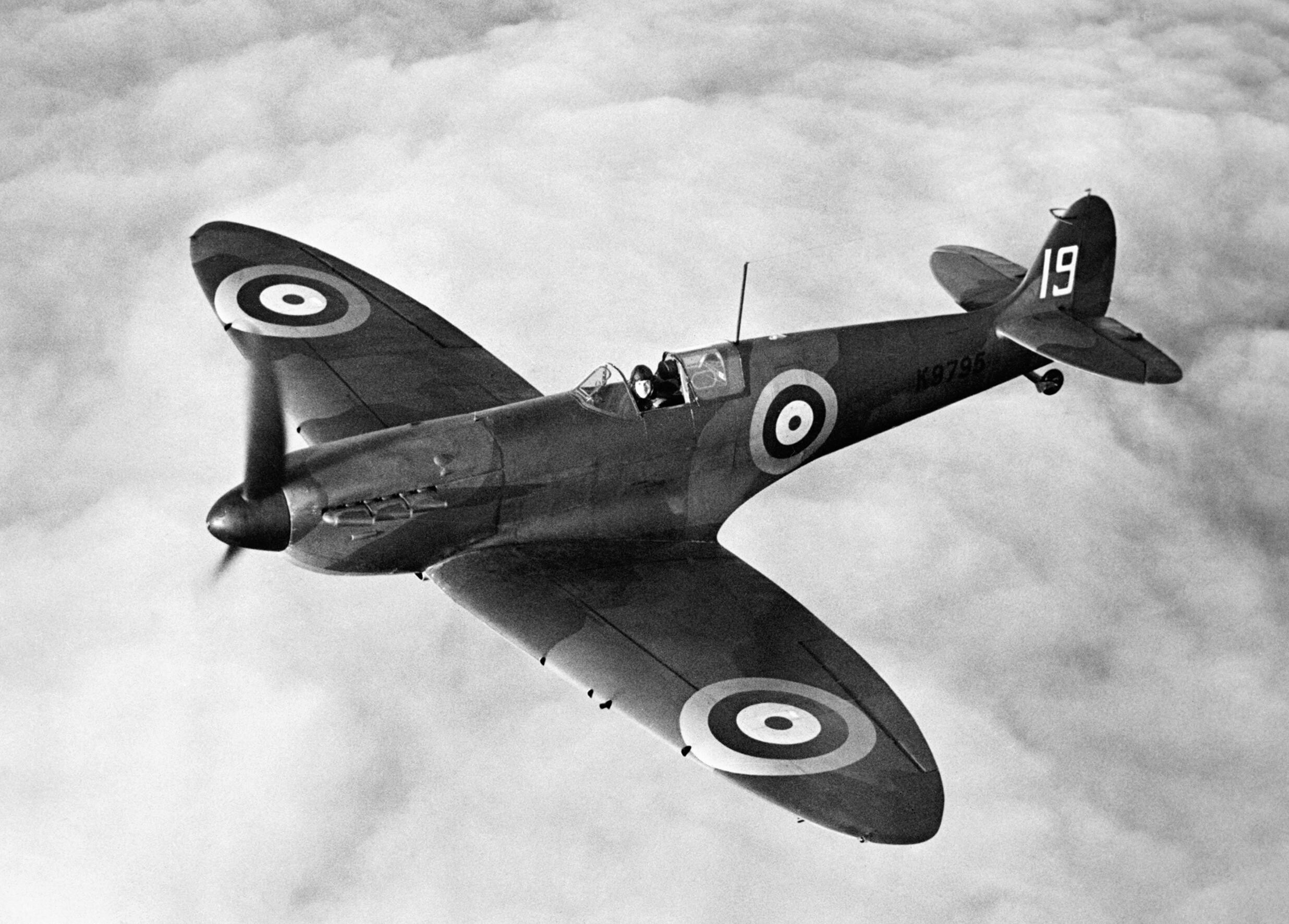
But this requirement was soon upgraded to an eight-gun fighter design – and the Spitfire Mk I was born.
Spitfire Mk I armaments
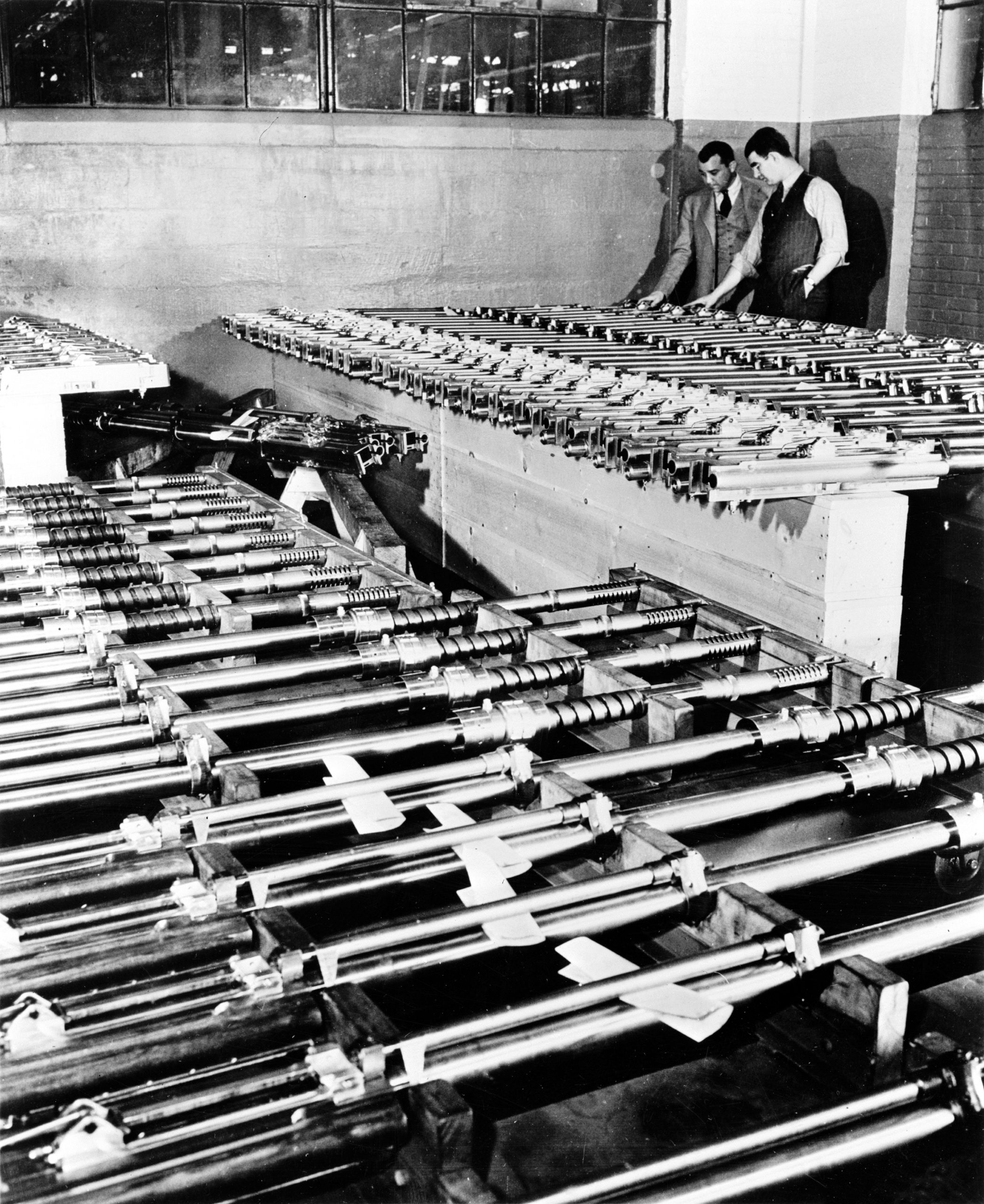
The Mk I carried eight Browning machine guns, each firing .303-inch calibre rounds like those of a rifle.
These were mounted in the wings with provision for at least 300 rounds of ammunition per gun, giving the aircraft a total load of 2,400–2,800 rounds.
This gave pilots the ability to deliver heavy, concentrated bursts of fire — but for only a short time.
Weaponry and wing design
The original A wing had been designed with four guns in mind. But its structure proved remarkably adaptable.
The .303 Browning machine guns were mounted behind the main spar and fired through blast tunnels routed through the spar and leading-edge D-box of the wing. Ammunition boxes were positioned between the guns.
Each gun was mounted on a pair of forks. The front fork was attached directly to the main wing spar and could be adjusted laterally while the rear fork could be adjusted vertically.
This system enabled armourers to make precise corrections to gun alignment.
Fine-tuning the Spitfire Mk I for combat
Synchronising eight guns to focus on a single point was a major task.
As combat tactics evolved, the required firing distance also changed. So armourers had to recalibrate many times.
This adaptability in early Spitfire wing design ensured the aircraft could keep pace with tactical needs, and it stands as an early milestone in the history of the Spitfire.
Operating Spitfire armaments in combat
Harmonisation
The first Mk I Spitfires had their eight wing guns harmonised to converge at ranges such as 1,200ft (370m), 1,350ft (410m) or even 1,950ft (560m).
Records of actual convergence distances vary between sources. That’s because squadrons sometimes set their guns slightly differently to official instructions.
But once combat experience began to accumulate, it was clear shorter distances were far more effective.
Ground crews reduced aircraft gun convergence to 750ft (230m), and in some cases as close as 360ft (110m).
This tighter harmonisation gave pilots a better chance of scoring decisive hits in fleeting engagements.
The gun button
The Spitfire’s firepower was all controlled from the pneumatic gun button on the spade grip at the top of the control column.
A rotating ring around the button could be turned to allow or prevent firing. This effectively gave the pilot ‘safe’ and ‘fire’ positions.
With the ring set to fire, pressing the button sent compressed air to operate the bolt actions of the guns.
At best, the eight-gun arrangement could pump about 2lbs of projectiles into an enemy aircraft in a single short burst.
But success depended on the pilot getting close enough, aiming accurately and holding steady. This highlighted the delicate balance between precision shooting and the Spitfire’s need for speed.
Deflection shooting
Pilot Officer Nigel Rose of 602 (City of Glasgow) Squadron, based at Goodwood in 1940, recalled his experiences of combat in his memoirs.
It wasn’t just about getting close enough to the target to make rounds count. Pilots also had to master deflection shooting tactics, which involved aiming ahead of the target so that bullets met it in flight.
Rose’s memoirs describe these tactics vividly:
“Having selected your target, you would turn your gun button on the control column to ‘fire’, and the next most important action was to ensure as best you could that you were not being targeted yourself!
Your own attack would usually be made from a stern or quarter beam; the former was the deadliest and anyone who has studied camera gun films will confirm this. A beam attack meant allowing correct ‘Deflection’ – i.e. the aim through the gun sight must be drawn forward to lead the target before firing. Some pilots such as Archie McKellar were known to favour a head-on attack. This was difficult to achieve but hugely demoralising to the opposing bombers.
You often hear the term ‘dog fight’, but in World War II the actual engagement was usually very brief. The instant reaction if you were being attacked was to go into the steepest turn you could manage to try and get on the attacker’s tail. This would usually mean losing consciousness temporarily.
Or you could turn on your back and dive right out, twisting and turning this way and that. Such a manoeuvre doesn’t sound very brave, but sometimes to run away allowed one to live and fight another day!
On levelling out from a 400mph dive it was quite astonishing how empty the sky was and often not a plane to be seen. Occasionally in the middle of a chaotic scrap, a Bf 109 or 110 would flash past you going in the opposite direction with breathtaking closing speed. There was little time to do anything but gawp and say a little prayer.”
Ammunition load
British Spitfires carried 300–350 rounds per gun, for a maximum of 2,800 rounds. This gave pilots just 14–18 seconds of firing time.
The German Bf 109, by contrast, often carried 1,000 rounds in each fuselage gun and 500 rounds in each wing gun, for a total of 3,000 rounds.
This gave Luftwaffe pilots precious extra seconds of fire compared to the RAF.
However, not all Bf 109s were equipped with cannons during the Battle of Britain.
Around a third of the Bf 109 aircraft used in the Battle were the E-1 variant, which carried just four machine guns.
Even towards the end of the Battle, about a third of replacements were refurbished E-1s with no cannon.
In practice, this meant that despite the apparent German advantage, many Luftwaffe fighters faced the Spitfire on far more equal terms. Ammunition limits on both sides shaped the fast, decisive nature of Battle of Britain dogfights.
A long-awaited development: Cannons arrive!
The next major change in Spitfire cannon development was the B wing, which introduced the Hispano 20mm cannon.
Integrating the Hispano cannons
In the B wing design, each wing replaced two Browning machine guns with a Hispano 20mm cannon. That left four Brownings in the outer wing positions.
The cannons provided much greater destructive power, capable of penetrating armour and delivering a heavier weight of fire.
A flaw in the design
The Hispano cannons were designed to help the Spitfire stay competitive with enemy fighters.
But early service was plagued by cannon stoppage problems. The weapons frequently jammed or misfired, limiting their effectiveness.
The 19 Squadron at Duxford was the first to evaluate the cannon-armed Spitfires. But the squadron commander demanded the return of their Spitfire Mk Ias with eight Brownings until the cannon stoppage problem was solved.
Solving the stoppage problem
Once modifications were made, cannon-armed Spitfire Mk Ibs were issued to 92 Squadron in November 1940. By then, the Battle of Britain was effectively over, so these fighters saw little action in the campaign.
The standard B wing arrangement of two Hispano cannons and four Browning machine guns was soon adopted on many Spitfires.
The cannon was mounted on its side, fed by a circular magazine holding up to 60 rounds of 20mm ammunition.
But because the magazine was slightly larger than the wing could accommodate, engineers added characteristic blisters above and below the wing.
Adopting the new Spitfire armament design
Despite initial problems, the B wing proved popular once the issues were fixed.
By 1941, the famous Bader Wing at RAF Westhampnett was flying mostly with B wing Spitfires.
Douglas Bader himself, however, refused to fly with cannons. He preferred the eight-Browning A wing, which he considered more reliable.
The B wing also introduced a new gun button: a rocker switch with three positions. This allowed the pilot to fire cannons alone, just the machine guns, or both together.
With so much flexibility, the reputation of Spitfire firepower continued to grow.
The C wing arrives
The third major evolution in Spitfire wing design was the C wing.
Unlike earlier designs, the C wing allowed flexible Spitfire armament combinations to be fitted in the field.
It could accommodate older setups like the eight-Browning A-wing layout or the cannon-and-machine gun mix of the B wing. But there was also the option for a new arrangement with two Hispano cannons mounted inboard near the wheel wells.
These were fed by a belt-fed ammunition system that supplied 120 rounds per gun, doubling the capacity of the B wing’s drum-fed cannons.
This field adaptability made the C wing configuration a milestone, giving pilots and squadrons the ability to tailor their firepower to operational needs.
Upgrading to the E wing
D wing Spitfires were unarmed variants used in photo-reconnaissance missions. That meant the next combat-ready development was the E wing upgrade.
This design featured an updated Browning machine gun chambered with heavier .50-inch calibre rounds – the same weapon carried by the American P-51 Mustang.
With heavier weaponry, the E wing Spitfire offered far greater firepower than models using the older .303 Brownings.
These .50-inch Browning machine guns were introduced during the production runs of the Mk IX and Mk XVI Spitfires. The reworked E wing arrangement combined a single inboard Hispano 20mm cannon with two .50-inch Browning mounted outboard.
With their low-altitude focus (LF) engines and E wing armaments, these planes came to have the full designations LF Mk IXe and LF Mk XVIe
Bomb-carrying Spitfires
In addition to air-to-air combat, the Spitfire was eventually adapted to carry and drop bombs.
This fighter-bomber conversion allowed the aircraft to participate in ground attack missions, supporting offensive operations in the later stages of World War II.
Spitfires from Mk V onwards could be fitted with wing or centreline bomb racks that carried two 250lb bombs or one 500lb bomb. These configurations gave the fighter enough destructive power to take out fortifications, trains, ships and vehicles.
Modified Spitfires were also adept at dive-bombing tactics. This involved approaching from a side angle, entering a steep dive, releasing their bombs and pulling out under high G-force.
Some late-war Spitfires were even fitted with rockets. But this wasn’t widespread and usually limited to two rockets per wing. Later Marks after the war had finished developed these rocket armaments further.
Step into the cockpit and fly a Spitfire
The story of Spitfire armaments and wing design is one of constant evolution.
From the eight-gun A wing to the cannon-armed B wing, the flexible C wing and the powerful E wing, every adaptation reflected the demands of a changing war. And later, as a fighter-bomber, the Spitfire proved itself versatile as well as deadly.
It’s been more than 80 years since the .50-inch Browning-equipped Supermarine Spitfire Mk IX was first developed.
But thanks to the loving care of maintenance of our Civil Aviation Authority (CAA) approved engineering team, this beautiful and deadly aircraft lives on today.
And you have the opportunity to fly it.
Not just see one or ride in one.
Actually fly it – no experience required.
Book your Spitfire flight experience today to experience the thrilling aerobatics of Britain’s bravest airmen in a genuine Supermarine Spitfire.

Comments