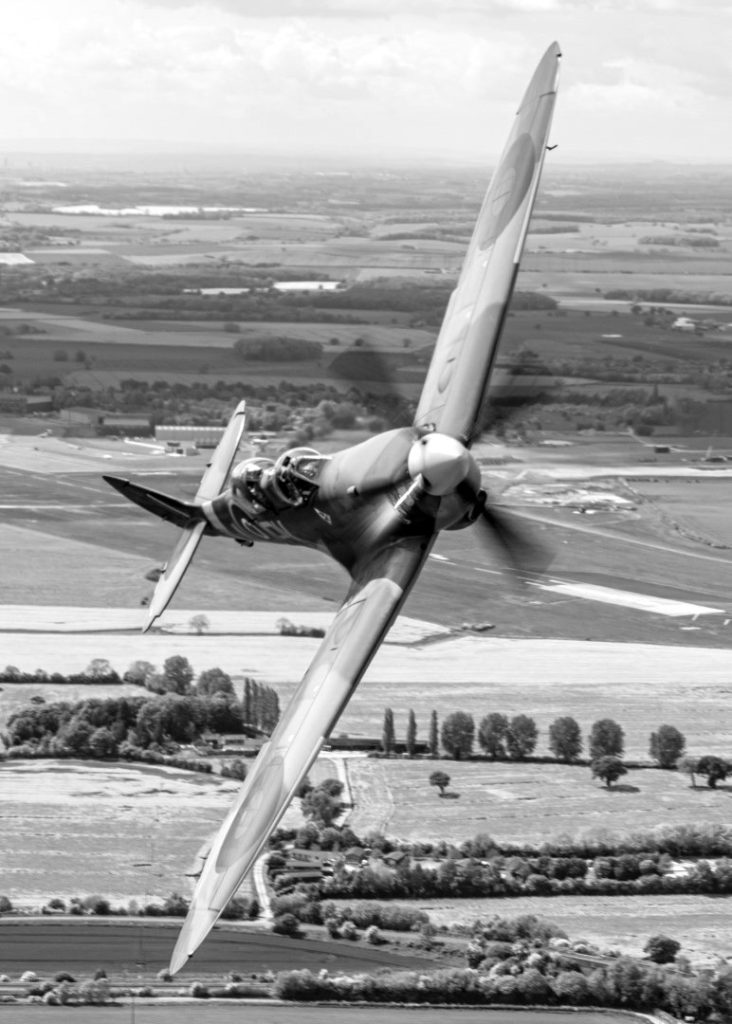
The Spitfire, also commonly referred to as the Supermarine Spitfire, is undoubtedly one of the most iconic and beloved aircraft in the history of aviation. It was the most widely produced and most strategically important single seat fighter plane of World War II. Its sleek design, exceptional performance, and pivotal role in World War II have cemented its place in the hearts and minds of aviation enthusiasts and historians alike.
In this blog post, we will delve into the rich history of the magnificent machine that is the Spitfire, exploring its development, crucial contributions during wartime, and its lasting legacy. And if you’re inspired by reading about the fascinating history of Spitfires, you can also find out how you can get the once in a lifetime chance to fly in one yourself.
WHO DESIGNED THE SPITFIRE?
The ingenious design of the Spitfire is down to the vision and engineering prowess of one man; Reginald Joseph Mitchell. This is where the history of the Spitfire begins, with R.J. Mitchell’s vision. Mitchell was a brilliant British aircraft designer, who had designed a series of impressive floatplanes in the 1920s to compete for the prestigious and highly coveted Schneider Trophy. One of these floatplanes designed by Mitchell, dubbed the S.6, actually set a world speed record of 357 miles per hour in 1929, so his talents and skills as an aviation engineer were in no doubt.
In the 1930s, Mitchell envisioned an advanced fighter plane that could counter the increasing threat of Nazi Germany. His vision resulted in the creation of the Supermarine Type 300, the prototype that would eventually become the Spitfire.
Innovative design
The Spitfire’s design was groundbreaking for its time. Whilst the Hurricane Hawker was also an excellent design, the Spitfire was much more innovative and radical in its design. Key features included a sleek, elliptical wing with an extremely thin airfoil that allowed for exceptional manoeuvrability and speed, especially in high altitudes. Its all-metal, stressed-skin aluminium structure and retractable landing gear were cutting-edge technologies that set it apart from its contemporaries.
Power and engines
The Rolls-Royce Merlin engine, a powerful 12-cylinder inline engine with a capacity ranging from 950 to 1,650 horsepower, depending on the specific variant, was selected to power the Spitfire. This choice proved to be pivotal in the aircraft’s success, as the Merlin engine provided the speed and performance required for aerial combat.
The Merlin-powered Spitfires, especially the Mk I and Mk II variants, played a pivotal role in the Battle of Britain due to this excellent performance. The engine’s reliability and power allowed the Spitfire to reach the full potential of its iconic elliptical wing design, which contributed to its exceptional manoeuvrability and speed.
The Rolls-Royce Griffon was another significant engine used in later variants of the Spitfire.
This 12-cylinder, liquid-cooled engine featured a larger displacement than the Merlin, ranging from 1,990 to 2,350 horsepower. Griffon-powered Spitfires, such as the Mk XIV, offered improved high-altitude performance and speed. The Griffon engine’s increased power necessitated changes to the Spitfire’s airframe, including a broader cowling to accommodate the larger engine. However, the Rolls-Royce Merlin engine is probably still the most famous engine associated with the Spitfire.
Spitfire’s Maiden flight
The Supermarine Spitfire took to the skies for the first time on March 5, 1936, marking the beginning of a legendary chapter in aviation history. This iconic British fighter aircraft first took to the skies at Eastleigh Aerodrome in Southampton, England, which is now Southampton Airport. Eastleigh was the site of the Supermarine Aviation Works, where the Spitfire was designed and built.
The aircraft was piloted by Joseph “Mutt” Summers, who was the chief test pilot for Vickers Supermarine. Summers was a highly experienced and skilled pilot who had previously been involved in testing several other Supermarine aircraft. The particular aircraft flown on this historic day was the Supermarine Type 300, which was essentially the prototype of the Spitfire. It was designed to meet the requirements of the Air Ministry’s specification F.7/30, which called for a high-performance interceptor fighter. The Supermarine Type 300, later to be known as the Spitfire, featured several of the innovative design elements we’ve already discussed, including its distinctive elliptical wing shape, retractable landing gear, and of course a powerful Rolls-Royce Merlin engine.
Needless to say, the maiden flight of the Spitfire was a roaring success. The iconic aircraft demonstrated excellent handling and performance characteristics, immediately showcasing its potential as a top-tier fighter plane. This initial flight demonstrated its remarkable potential and set the stage for further development.
The Spitfire in wartime service
During World War II, the Spitfire served in multiple roles, including as a fighter, interceptor, and reconnaissance aircraft. Its adaptability made it a versatile asset for the Allied forces.
The Battle of Britain
The Spitfire’s defining moment came during the Battle of Britain. The Supermarine Spitfire’s contribution to the Battle of Britain, a pivotal air campaign during World War II, cannot be overstated. Alongside the Hawker Hurricane, the Spitfire played a crucial role in defending British airspace against the German Luftwaffe from July to October 1940, earning its reputation as a formidable adversary.
Some of the key ways in which the Spitfire contributed to the Battle of Britain include:
Air Superiority
The Spitfire was a high-performance fighter aircraft, renowned for its speed, agility, and firepower. It was capable of taking on the best German fighters, particularly the Messerschmitt Bf 109, on equal terms or even with an advantage in certain aspects, earning air superiority.
Improved Dogfighting Capability
The Spitfire’s exceptional manoeuvrability and tight turning radius made it highly effective in dogfights. British pilots could engage in close-quarters combat and outmanoeuvre their opponents, gaining an edge in aerial battles.
Versatility
The Spitfire was versatile and capable of performing a wide variety of different roles. It could engage enemy fighters, intercept bombers, escort reconnaissance aircraft, and conduct ground attacks when necessary. This adaptability allowed it to respond to changing battlefield situations.
Escort for Bombers
The Spitfire, along with the Hurricane, provided vital escort protection to British bombers, such as the Avro Lancaster and the Vickers Wellington. This safeguarded the bombers from German fighter attacks during their missions.
Hit-and-Run Tactics
Spitfire pilots often employed hit-and-run tactics, swooping down on German bombers and fighters before swiftly disengaging. This strategy disrupted German formations and created confusion among enemy pilots.
Interception of High-Altitude Bombers
The Spitfire’s design allowed it to operate effectively at high altitudes, enabling it to intercept German bombers flying at medium and high altitudes. It excelled in high-altitude combat, ensuring that enemy bombers faced fierce resistance.
Psychological Impact
The Spitfire, with its sleek design and distinctive elliptical wings, became a symbol of British resistance and determination. Its presence in the skies boosted morale among both the British public and RAF pilots, and struck fear into the hearts of enemies who saw it.
Continuous Production
The British aircraft industry ramped up Spitfire production during the Battle of Britain, ensuring a steady supply of aircraft. This allowed the RAF to replace losses and maintain a robust fighter force throughout the campaign. The Spitfire’s design also made it relatively easy to maintain and repair, reducing downtime and ensuring that aircraft could return to service quickly after sustaining damage.
Protection of British Cities
By thwarting German attempts to gain air superiority, the Spitfire helped protect British cities from devastating aerial bombardment. This was a critical aspect of the battle, as the Luftwaffe’s failure to establish air dominance over Britain led to the abandonment of Operation Sea Lion, the planned invasion of Britain.
In the end, the Spitfire, along with the Hurricane and the valiant efforts of British pilots, played a hugely significant role in the victory of the Battle of Britain. Their resilience and skill denied the Luftwaffe air superiority, which was a turning point in the war and a testament to the Spitfire’s enduring legacy as one of the most iconic fighter aircraft in history.
Global deployment
While the Spitfire is often associated with the Battle of Britain and the war in Europe, it saw action in various other theatres of war all over the world, for example:
Spitfires were deployed extensively in the Mediterranean, where they saw action over North Africa, Italy, and the Mediterranean Sea.
Spitfires were also deployed in North Africa to counter the Axis forces in campaigns like Operation Torch and the Tunisian Campaign.
They were operated by several Commonwealth air forces in the Asia-Pacific Theater, including Australia, New Zealand, and India.
The Royal Australian Air Force (RAAF) and Royal New Zealand Air Force (RNZAF) used Spitfires in various roles, including air defence and ground attack.
The Spitfire served with the RAF in Burma, where it played a role in the Burma Campaign against Japanese forces.
The Chinese Nationalist Air Force (Kuomintang) received Spitfires as part of lend-lease agreements with the Allies. These aircraft aided Chinese efforts against Japanese forces.
The Soviet Union received a limited number of Spitfires under the Lend-Lease program. These aircraft were primarily used for evaluation and training purposes.
After World War II, the Spitfire continued to serve in various air forces around the world, including Belgium, France, Greece, Norway, and the Netherlands. Many of these nations operated surplus Spitfires as they transitioned to newer jet-powered aircraft.
The Israeli Air Force (IAF) used Spitfires during the 1948 Arab-Israeli War. These aircraft were instrumental in securing air superiority over the region.
The Spitfire’s enduring impact
The Supermarine Spitfire, born out of the visionary mind of R.J. Mitchell, and refined through years of development, etched its name into the annals of aviation history. Its remarkable design, combat prowess, and lasting legacy make it a symbol of innovation and courage.
As we reflect on the history of the Spitfire, we are reminded not only of its pivotal role in World War II but also of the indomitable spirit of those who designed, built, and flew this extraordinary aircraft. The Spitfire’s enduring impact on aviation history serves as a testament to human ingenuity and the power of determination in the face of adversity.
The Spitfire’s iconic status continued to grow after the war. It became a symbol of British resilience and determination during the darkest days of the conflict. Pilots and historians continue to celebrate its legendary status.
The Spitfire remains a popular aircraft among aviation enthusiasts, and many organisations and individuals have dedicated themselves to the preservation and restoration of these historic planes. Numerous Spitfires have been preserved and are displayed in museums all around the world. However, for the chance to actually experience the thrill of flying in one of these amazing machines, you’ve come to the right place.
At Spitfires.com we offer the once in a lifetime opportunity to fly in a Spitfire. You can look on our website for more information on our Spitfire flights and where you can fly from, or feel free to get in touch with us to discuss your Spitfire adventure.

Comments