


Spitfire 90th anniversary circumnavigation OF GREAT BRITAIN
Take part in a historic Spitfire tour of GREAT BRITAIN
On March 5, 1936, at around 4:43 pm, Captain Joseph ‘Mutt’ Summers climbed into the cockpit of K5054, a Supermarine Type 300 - the prototype of the now world-famous Spitfire. The flight lasted just 8 minutes. And on landing, Summers simply said: “Don’t change a thing”.2026 marks the 90th anniversary of that first flight of the Spitfire. To commemorate the occasion, we’ve painted our two-seat Spitfire BS410 in the colours of K5054. Working with the Royal Air Force, we’ll fly the aircraft on a tour of Great Britain in a series of 9 flights - one for every decade of the 90 years being commemorated. And you have the opportunity to take part in this historical once-in-a-lifetime event, all while supporting two worthy charities.

It’s not just the RAF that are joining us on this once-in-a-lifetime journey - you can come, too! We’re hosting a charity auction where you can bid to fly in the rear seat of our Spitfire BS410, a genuine wartime aircraft that fought in World War II. All of the proceeds will go to the Mark Long Trust and the RAF Benevolent Fund.This is the only opportunity anyone will ever have to fly these routes as part of an exclusive celebration of Spitfire history. By making a winning bid, you forever become a part of that history. For the true aviation enthusiast, this is an unmissable chance to experience the craft at the highest level, all while helping essential charities.Looking over the famed elliptical wing of the Spitfire as it first appeared, flying in formation with the RAF and seeing the UK as few ever do, you know you’ve made your mark on history.
OUR Sponsors


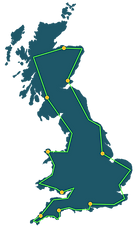
The route
Our first flight will depart from Southampton International Airport, formerly Eastleigh Airport and the location of the first flight of the Spitfire in 1936. We’ll then circumnavigate Great Britain, flying over key historic Spitfire locations such as:
-
Reginald J. Mitchell’s grave
-
The site of the original Spitfire factory
-
The Needles
-
Beachy Head
-
The Battle of Britain Memorial at Capel le Ferne
-
The White Cliffs of Dover
-
Martlesham Heath - where much of K5054's further flight testing was done
-
RAF Coningsby, the current home of the RAF’s Battle of Britain Memorial
-
ands many many more!
flying in formation with the raf

To mark the 90th anniversary, the RAF will launch at least one escort on each of our 9 flights to accompany the two-seat Spitfire on its journey. And we’ll be capturing air-to-air photographs of these historic formation flights to share as part of the event. These aircraft could include:
-
A Phenom multi-engine trainer trainer
-
Lockheed Martin F35 Lightning II
-
Battle of Britain Memorial Flight aircraft
-
Eurofighter Typhoon
-
The Boeing CH-47 Chinook
-
BAE Systems Hawk T1's of the world famous RAF Aerobatic Team, The Red Arrows.
COMMMEMORATION GOALS
The Spitfire 90th anniversary circumnavigation of Great Britain is a joint initiative by the RAF (led by the Battle of Britain Memorial Flight) and Spitfires.com.The BBMF has been commemorating WWII since 1957, connecting the public with the great bravery and sacrifice of everyone who played a part. They host flypasts and airshow displays in summer, with hangar tours of their wartime fleet all year round. For 15 years, Spitfires.com has brought aviation history to life with passenger flight experiences in authentic two-seat Spitfire TR9s. We also offer commemorative displays and Spitfire pilot training, giving people many different ways to experience aviation history. This initiative embodies the strengths of both our organisations. Together, we want to achieve:

1
A NATIONAL EVENT TO COMMEMORATE THE FIRST FLIGHT OF THE SPITFIRE
2
A SHOWCASE OF THE TECHNICAL ADVANCEMENT OF RAF AIRCRAFT SINCE 1936
3
A FUND-RAISING EVENT TO HELP OUR SUPPORTED CHARITIES

The Spitfire represents the finest hour of the RAF, where the aircraft tipped the balance to victory in the Battle of Britain. But our 90th anniversary flight also gives the RAF the opportunity to demonstrate the technical advancements of its current fleet. As such, different aircraft from modern-day squadrons will accompany the Spitfire on each of its 9 flights. That includes the BBMF, who have played a major role in keeping WWII aviation history alive. Here are just some of the aircraft you might be lucky enough to see over your wing as the winning bidder.


SUPPORTED CHARITIES
This commemoration is an opportunity to raise a significant amount of money for our chosen charities: the Mark Long Trust and the RAF Benevolent Fund. Our target is to raise at least £150k, with all proceeds from the auction being split between the two.

THE RAF BENEVOLENT FUND
From mobility aids and confidential counselling to financial grants, the RAF Benevolent Fund provides lifelong support to serving and ex-serving RAF personnel and their families. They also maintain and preserve the RAF Memorial and RAF Bomber Command Memorial in London on behalf of the nation.

HISTORY OF THE original SPITFIRE PROTOTYPE - K5054
.jpg)
The need for superior aircraft
In the mid 1930s, tensions in Europe began to rise once more. So the RAF sought a new generation of fighter aircraft with the firepower necessary to stop enemy bombers in their assaults on the UK. The competition to leap forwards in engineering and aerodynamic design was set by the Air Ministry - and the race was one!
R J Mitchell and the Type 300
Reginald Joseph Mitchell, chief designer at Supermarine Aviation Works, accepted this challenge. Mitchell was known for his expertise in streamlined, high-speed aircraft. And from his drawing boards emerged a radical design: the Type 300. This aircraft originated from the Type 224, and would go on to become the Supermarine Spitfire. The first iteration of the new fighter aircraft didn’t meet the brief, and was pipped to the post by the Gloster Gladiator. But Supermarine continued to develop the Type 300 against the prototype Hawker Hurricane as the first 8-gun monoplane fighters. Supermarine persevered with its design. And the rest, as they say, is history.
The technical advancements of the Spitfire prototype
At its heart, the Spitfire represented a leap in aerodynamic thinking. Mitchell and his team fashioned a semi-monocoque all-metal fuselage, a structure that provided strength with minimal weight. But the most striking feature was the aircraft’s elliptical wing: elegant, thin and highly efficient. Not only was the wing beautiful to look at, but its shape reduced drag and allowed room for 8 of its .303 machine guns. This met the RAF’s updated armament specification from 4 to 8 guns. The aircraft was powered by one of the era’s most promising engines, the new Rolls-Royce Merlin - initially the prototype Merlin C, which delivered around 990 hp.
A naturally evolving design
For the initial tests, a two-bladed, fixed-pitch wooden propellor was fitted. And other features like the armament and fairings were absent. The fuselage and radiators were hand-built, with craftsmen cutting the aluminium alloy skin to the elliptical contours of the wings and fuselage. Throughout the build, adjustments were ongoing. It was an almost organic evolution of design. The prototype originally sported a stubby engine intake and tail skid. But these details were later refined or abandoned as the aircraft matured.
The first flight of the Spitfire
By early March 1936, the Spitfire prototype, K5054, was ready for airborne testing at Eastleigh Aerodrome (not Southampton Airport). The preparation for the flight and the supervision of the aircraft was undertaken by the Supermarine foreman, Ken Scales. Ken was extremely proud of the new design. And as mentioned by Jeffery Quill in his book Birth of a Legend: “He hardly let the aeroplane out of his sight, and attended it in a manner reminiscent of a head lad responsible for the welfare of a champion race-horse”. The impact of K5054 reached far beyond its first flight. Within a few years, the Spitfire became synonymous with the RAF’s defence of Britain. And it was built in vast numbers across 24 variants.
.jpg)
R J MITCHELL
Reginald Joseph Mitchell (1895-1937) was the brilliant British aeronautical engineer whose vision gave the world the Supermarine Spitfire. Born in Kidsgrove, Staffordshire, he began his career as an apprentice at Kerr Stuart. He joined Supermarine in 1917, quickly rising to become chief designer. Mitchell first gained international recognition through his sleek high-speed seaplanes. That included the racing aircraft that won the Schneider Trophy in 1927, 1929 and 1931. These achievements directly influenced the aerodynamic principles later seen in the Spitfire’s elliptical wings and streamlined fuselage. Despite battling cancer during the aircraft’s development, Mitchell pushed relentlessly to perfect the design of the prototype K5054. Thanks to his effort, their aircraft took its first flight in 1936, within Mitchell’s lifetime. He didn’t live to see the Spitfire’s crucial role in the Battle of Britain, passing away in 1937 at just 42 years old. But his legacy endures as one of Britain’s most important aircraft designers.