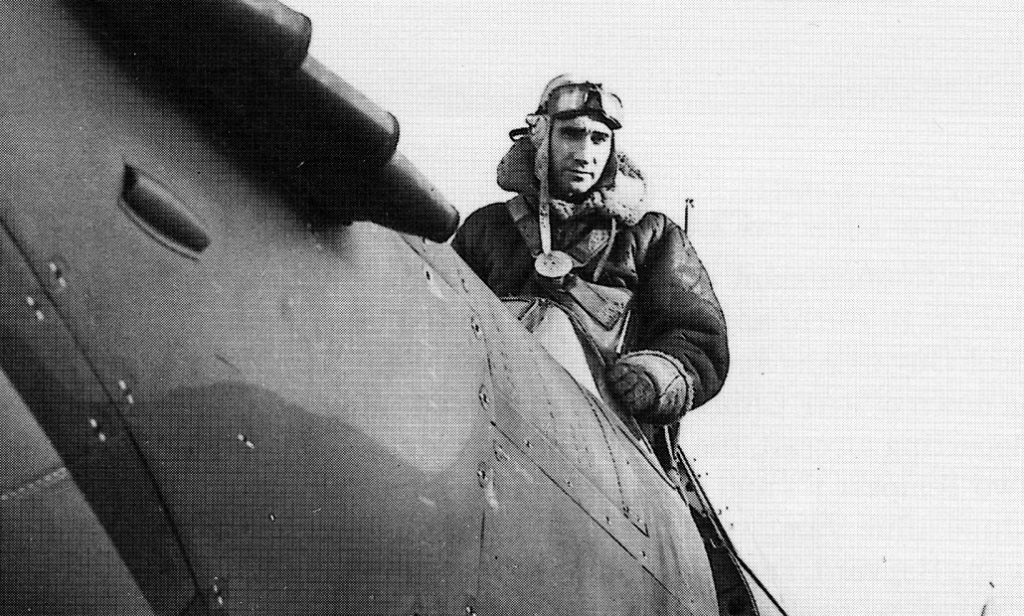
The biography of Jeffrey Kindersley Quill, OBE, AFC, FRAeS
People often say “nobody remembers the second person to step on the moon” – much to the chagrin of Buzz Aldrin.
But while Joseph “Mutt” Summers claims the distinction of being the first Spitfire test flight pilot, his successor Jeffrey Quill went on to write an unforgettable entry in aviation history.
Throughout his career, Quill flew every version of the Supermarine Spitfire and its naval variant the Seafire without exception. And his contributions to British aviation were so great that he not only received many awards and accolades, but had several other notable proceedings named after him. Even today, Quill’s actions echo across time, guiding interest in and development of modern aircraft.
In this short biography of Jeffrey Quill, we explore the key events in the life of the world’s most legendary Spitfire test pilot. But there’s no reason to stop at simply reading the words. You can honour Quill’s legacy first-hand with your very own Spitfire flight experience.
Book your Spitfire flight today from one of 10 locations across the UK to feel the power and thrill of Britain’s most iconic aircraft.
1913-1931: Early life
Jeffrey Kindersley Quill was born on 1st February 1913 in Littlehampton, Sussex, the youngest of 5 children.
As a young lad, he went to school at Lancing College, which overlooked the Shoreham aerodrome. At the time, the aerodrome was just a grass field with some old hangars and a wooden hut for a flying club. But the aircraft that flew overhead lit a fire in Quill, who also attended the annual RAF displays at Hendon.
And before he left school in 1931, he’d already made up his mind to pursue a non-commissioned career in the RAF.
1931-1933: Learning to fly
At 18 years old, Quill was accepted into the RAF as an acting pilot officer.
His aviation career began at No. 3 Flying Training School at Grantham, Lincolnshire, almost 200 miles north of his family home in Sussex. There, he learned to fly on Avro Tutor biplanes.
It was typical for new pilots to go solo after 9 hours of flight. But Quill was such an exceptional pilot that he started flying alone after just 5h 20m of practice. And shortly, he graduated to Armstrong Whitworth Siskin IIIA advanced trainers.
The following year, in September 1932, Quill joined No. 17 Squadron RAF at Upavon, Wiltshire, where he started flying British Bulldog fighters. He flew as often as he could, practising aerobatics and flying in cloud to learn every aspect and quirk of his aircraft.
But Quill never let his love of flying disturb his awareness of its many dangers. And in his 1983 autobiography, he wrote:
Unless aerobatics were practised assiduously to the point where one was familiar with every conceivable combination of speed and attitude of which the aircraft was capable, one was not master of the aeroplane. Therefore a day would come when the aeroplane decided that it was in charge instead of the pilot, and that would be the last.
As a child, he could only marvel at the aircraft flying overhead at Hendon. But in June 1933, Quill took part in the display himself, demonstrating low flying in a mock bombing attack.
No. 17 Squadron also conducted service trials of new fighters for the Aeroplane and Armament Experimental Establishment. So Quill was privileged to take part in the evaluation of the Armstrong Whitworth A.W.16.
1933-1935: Earning recognition for meteorological flight
At the end of 1933, Jeffrey Quill was posted at the RAF Meteorological Flight at Duxford, Cambridgeshire.
The Flight’s role was to fly twice-daily missions (except on Sundays) up to 25,000 ft to collect temperature, humidity and cloud formation data at 1,000 ft intervals to inform the UK’s weather forecasting.
Quill and the rest of his small team flew obsolescent Siskin IIIAs, reminiscent of his time at No. 3 Flying Training School. But there were a few changes to the basic aircraft that made this task much more dangerous.
To capture the necessary atmospheric data, these aircraft had open cockpits, no artificial horizon, no radio and only rudimentary blind-flying instruments – a Reid and Sigrist turn-and-bank indicator and an inclinometer.
If the weather was particularly foul, the Flight would call off its scheduled ascent – or, at least, that’s how it was usually done. But after Quill took command in November 1934, he and his team flew every single slot for a whole year, even in ‘unflyable’ weather.
For this exemplary devotion to duty, Quill received the Air Force Cross at the age of 23.
1935-1939: Becoming a prolific Spitfire test pilot
On 18th November 1935, Jeffrey Quill attended an interview with Vickers (Aviation) Ltd. And on 6th January 1936, he joined Vickers at Brooklands in Weybridge, Surrey as assistant to their chief test pilot, Joseph “Mutt” Summers.
Quill’s first entry in the history of the Spitfire came on 26th March 1936 when he first flew the prototype Supermarine Type 300 K5054. This was the same aircraft Spitfires.com paid homage to during our Spitfire 90th anniversary flight charity auction, with our BS410 painted in its classic cerulean blue.
Mutt Summers had made the prototype’s maiden flight 3 weeks earlier. But while his job was to test the aircraft’s airworthiness and handling, Quill’s was to get the Spitfire cleared for acceptance by the RAF.
The aircraft needed a lot of work before it was considered safe for young RAF pilots to fly. But in July 1938, the Supermarine Spitfire finally entered service.
That same year, Quill transferred to Vickers Supermarine full-time, taking over from Summers as the company’s chief test pilot. While he was indeed the second person to fly the prototype, Quill eclipsed this accolade with one far more impressive: test-flying every single mark of the Supermarine Spitfire and Seafire.
1939-1945: World War II
1940: A commitment to authentic combat experience
During World War II, Quill led development and production flying at Vickers Supermarine.
But test flying aircraft could only give Quill so much knowledge about how it would perform in the field. So he resolved to engage in first-hand combat flying to gain a full understanding of the needs of real fighter pilots.
After the fall of France in 1940, Quill was temporarily released from Vickers Supermarine on 5th August 1940 to join No. 65 Squadron at RAF Hornchurch in Essex. But secretly, he had hoped it would be a permanent appointment.
On 16th August, during the Battle of Britain, Quill shot down a Messerschmitt Bf 109. And two days later, he shared a victory over a Heinkel He 111.
To Quill’s disappointment, he was recalled after just 19 days to test the Spitfire Mk III. But his combat experience inspired him to make the Spitfire the world’s greatest fighting machine.
What’s more, his brief time as a fighter pilot highlighted two key problems with the Spitfire:
- At high speed, the stick force from the ailerons had been very heavy. This, it turned out, was caused by the ballooning effect of their fabric coverings
- Quill was also concerned about the rearward vision from the cockpit. So the canopy and rear fuselage were improved to boost the optical quality of the cockpit side panels
Later in 1940, Quill became chief test pilot for Vickers Armstrong’s (Supermarine) Works.
1942: Operation Airthief and the capture of a German warbird
The Spitfire was certainly a phenomenal fighter aircraft. Its history or armaments and wing designs showed a constant drive for better firepower and maneuverability. And the Spitfire’s need for speed made it one of the top 10 fastest Second World War aircraft.
But by 1942, the Luftwaffe’s Focke-Wulf Fw 190 was gaining the edge over Allied fighters. And capturing an airworthy example for study was considered an urgent priority.
Quill was on standby to be taken to France to hijack an Fw 190 back to England. His friend, Captain Philip Pinckney, a Commando officer, made a risky proposal for approval by Combined Operations Headquarters codenamed ‘Operation Airthief’. The plan was for Pinckney and Quill to penetrate an airfield in occupied France.
Privately, Quill didn’t believe the two would survive the daring operation. But thankfully, he would never have to find out.
On 23rd June 1942, a German pilot mistook the British Channel for the English Channel and landed an Fw 190 3-A at RAF Pembrey in south Wales, accidentally delivering the target aircraft straight into British hands.
Shortly after, Quill flew the captured German aircraft at Farnborough, Hampshire.
1943-1943: Fleet Air Arm
In January 1943, Jeffrey Quill was appointed an Officer of the Order of the British Empire (OBE), a prestigious honour awarded by King George VI for his distinguished contributions to aviation. And from November 1943 to April 1944 he served as a lieutenant commander with the Fleet Air Arm, a branch of the Royal Navy responsible for operating aircraft from ships and carriers.
After the Supermarine Seafire was introduced, the Fleet Air Arm had suffered serious losses in deck-landing accidents. So Quill was responsible for helping to develop better carrier-deck-landings with the aircraft.
Once he’d completed a course at RNAS East Haven, a Deck Landing Training School in Angus, Scotland, Quill served on the trainer carrier HMS Ravager. Later, he joined the escort carrier HMS Attacker, which had two Seafire squadrons on board – No. 879 and No. 886. He flew with both squadrons, and was later attached to the shore-based No. 1837 Squadron.
Captain Eric Brown, a famous naval test pilot who flew more types of aircraft than anyone in history and held the world record for the most aircraft carrier deck take-offs and landings performed, wrote of Quill: “Jeffrey was an inspired choice, as he had the analytical mind of a superb test pilot, trained to find answers to any flight problem.”
During his time with the Navy, Quill made more than 75 deck landings covering all British and American carrier-borne aircraft types, with the sole exception of the Fairey Firefly. And by the time he returned to Supermarine, he thoroughly understood the causes of carrier-deck-landing accidents.
1945-1996: Postwar achievements
Following the Second World War, Jeffrey Quill continued as a test pilot. His work included flying the latest Supermarine jets, such as the Attacker and the Swift.
By 1947, he’d conducted the maiden flights and led the development and production test flying for all 52 variants of the Spitfire. And the aircraft held the accolade of being the only Allied fighter to remain in full production and frontline service throughout World War II.
But Quill wasn’t only responsible for Spitfire development. He also made the first flights of a number of other aircraft, including the:
- Dumbo: An experimental variable-incidence wing torpedo bomber
- Spiteful: The fighter aircraft designed as the successor to the Spitfire
- Seafang: A naval fighter aircraft variant of the new Spiteful
- Attacker: The Royal Navy’s first jet fighter
After a long and storied career as a test pilot, Quill later became a military aircraft marketing executive for the British Aircraft Corporation.
Following his retirement, he lived with his wife in the village of Andreas on the Isle of Man. During this time, he chronicled the legacy of the Spitfire as the author of:
- In the Cockpit: Flying the World’s Great Aircraft (1982)
- Spitfire: A Test Pilot’s Story (1983)
- Birth of a Legend: The Spitfire (1986)
Quill was later elected president of the Spitfire Society. And he participated in an annual lecture given by the Association of Manx Pilots. After his death, this became known as the Jeffrey Quill Memorial Lecture.
1996: The death of a legendary Spitfire test pilot
Jeffrey Quill died at his home on 20th February 1996. He was buried in St Andrew’s churchyard near the former fighter station RAF Andreas, which operated Spitfires from 1941-1942.
Following his death, the British aviation society the Air League created a new award in his name. And every year since 1997, they’ve awarded the Jeffrey Quill Medal for “outstanding contribution to the development of air-mindedness in Britain’s youth”.
Continue Quill’s legacy with your own Spitfire flight experience
Many years of hard work and determination went into making the Spitfire a highly effective fighter aircraft. And had it not been for Jeffrey Quill, the world would be a very different place than it is today.
But while Quill is now at rest in the pages of history, his contributions to global aviation live on to this day. That means you still have the opportunity to step into the cockpit of Britain’s most iconic aircraft and fly a Spitfire yourself.
Book your Spitfire flight experience online today and take to the skies from one of 10 key locations across the Spitfire’s wartime past.

Comments