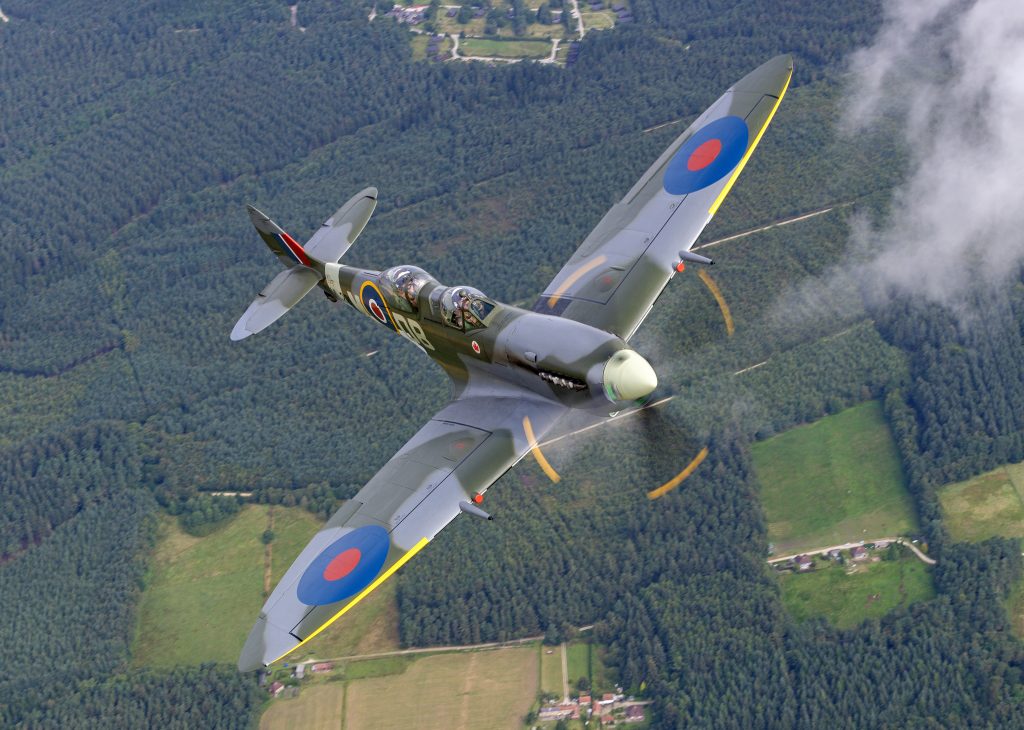
Exploring the role of Goodwood in the Second World War
Goodwood Aerodrome in West Sussex is the beloved home of Spitfires.com.
But before it became the civilian airport it is today, the site began life as RAF Westhampnett, a satellite fighter airfield serving nearby RAF Tangmere.
RAF Westhampnett operated from 1940-1946. So while it missed the early years of the Second World War, its location close to the south coast made it critical to operations over the English Channel and northern France.
The WWII history of RAF Westhampnett has long since passed. But every year, hundreds of visitors rekindle those tales of immense bravery, tactical genius and astonishing skill with unforgettable Spitfire flight experiences at Goodwood Aerodrome.
Book your Spitfire flight online today to write your own entry in the history of RAF Westhampnett.
How RAF Westhampnett was established as a WWII airbase
The rapid expansion of the Luftwaffe during the 1930s forced Britain to increase the size of the RAF and provide more bases for its growing fighter force.
Permanent bases like RAF Tangmere contained conspicuous brick buildings and concentrated large numbers of aircraft in locations already known to German reconnaissance planners. So Fighter Command developed satellite airfields near major stations to help squadrons disperse their aircraft and reduce the damage that a single bombing raid could cause. These sites also offered emergency landing grounds for damaged aircraft or pilots unable to return to their assigned station.
In 1938, the Air Ministry approached Frederick Gordon-Lennos, the 9th Duke of Richmond and Gordon, to discuss establishing an emergency landing and dispersal ground on the Goodwood Estate.
The Duke agreed to make Westhampnett Farm available. And so hedges were removed and fields were combined to create a large grass landing area. The wartime landing ground eventually contained 3 grass airfield directions, with the longest extending to approximately 1,300 metres.
Early facilities were basic. Tents were used in place of full buildings. And engineers often performed aircraft maintenance out in the open.
The station later acquired blister hangars, a Type T1 hangar, technical buildings and accommodation for more than 1,400 personnel.
RAF Westhampnett became an operations satellite of RAF Tangmere within No. 11 Group, Fighter Command. This group was responsible for defending London and southeast England against attacks from across the Channel.
The role of RAF Westhampnett during the Battle of Britain
RAF Westhampnett became operational during the opening weeks of the Battle of Britain, which is recognised to have run from 10 July to 31 October 1940.
No. 145 Squadron arrived at RAF Westhampnett on 31 July 1940. They were commanded by Squadron Leader John Peel, who had already led them during the opening stages of the Battle of Britain.
The Squadron operated Hawker Hurricanes from the grass airfield. And they entered a particularly intense period of operations as the Luftwaffe attacked Channel shipping, south-coast ports and RAF fighter stations.
Westhampnett’s fighters helped defend the stretch of coastline extending from Brighton to the western side of the Isle of Wight. Their aerial opponents included Junkers Ju 89 dive bombers, Messerschmitt Bf 109 fighters and Messerschmitt Bf 110 heavy fighters.
No. 145 Squadron suffered heavy casualties. Of the 25 pilots who flew with the unit, 11 were killed.
No. 602 (City of Glasgow) Squadron replaced No. 145 on 13 August 1940, arriving just as the Luftwaffe began concentrating more heavily on Fighter Command’s airfields and infrastructure. This group operated the iconic Supermarine Spitfire fighter aircraft. And in total, 6 of their pilots were killed during the Squadron’s time at RAF Westhampnett.
RAF Tangmere was attacked and badly damaged more than once during the Battle of Britain. But RAF Westhampnett escaped direct bombing. So by dispersing fighters and personnel away from permanent stations towards satellite airbases, Fighter Command was successful in limiting its losses and casualties.
Fly a Spitfire over the English Channel
Soar through the same skies as history’s most legendary fighter pilots in a genuine WWII Spitfire aircraft.

Comments