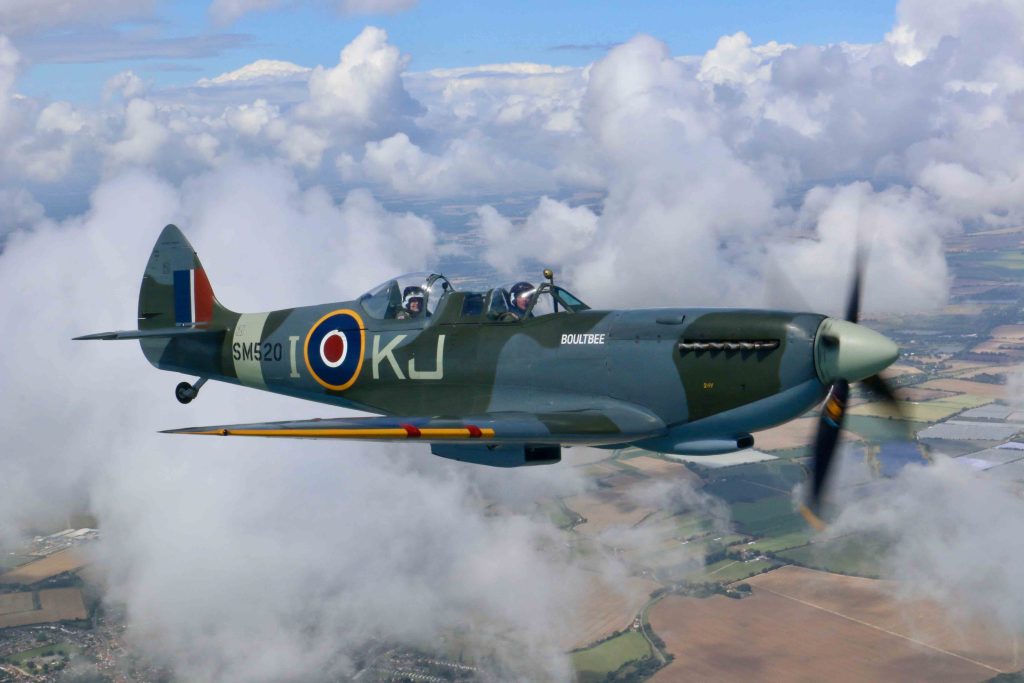
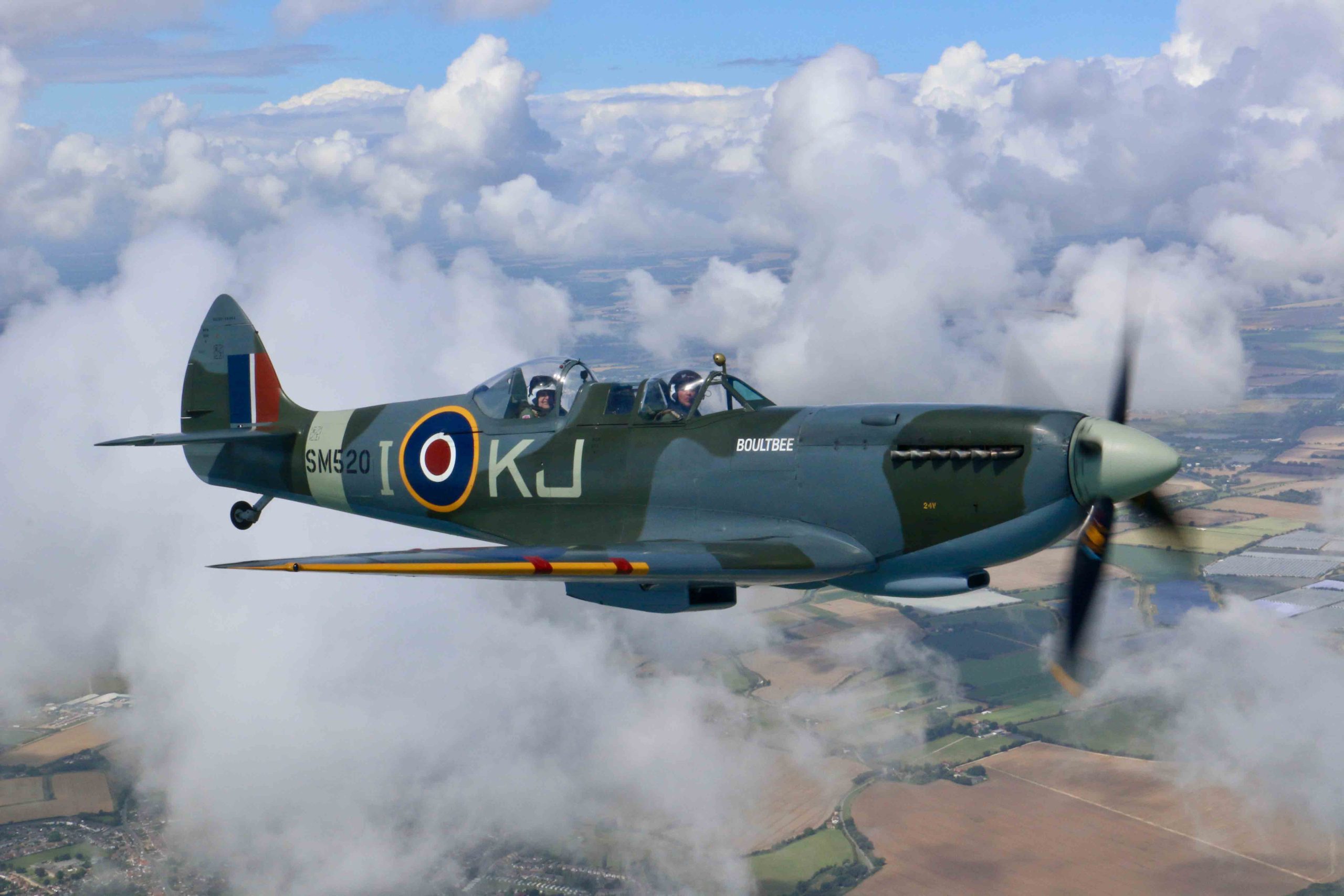
It was with great sadness we heard the news of Wing Commander Owen Hardy’s passing on January 4th 2018 at the age of 95. For his exploits as a fighter pilot in World War II he was a recipient of both Britain’s Distinguished Flying Cross (DFC) and Bar and France’s Legion d’Honneur.
Born on July 31st 1922 in Auckland, New Zealand it was with the Royal New Zealand Air Force (RNAF) that Owen Hardy first learned to fly at the age of 18. He grew up on model aeroplanes, and with the prospect of conscription on the horizon said that for a young man with a keen interest in aviation joining the Air Force seemed the only sensible course of action.
He’d soon swapped written tales of World War I fighter aces for aerial exploits of his own, having found his way to Canada for flying training and then gone on to England to fly a variety of aircraft, including in his own words “the miracle aircraft of that time, the Spitfire” of which he wrote:
The jump from flying a Harvard with its short nose to flying a Spitfire with four yards between you and the propeller and with twice the power was a mind boggling thought. But in the air the Spitfire was docile by comparison. The controls were light and sensitive and there was not a trace of viciousness if the aircraft was heavily mishandled. In fact, the Spitfire could be flown along straight and level in a completely stalled state; it would not even drop a wing when stalled under high G loads in a steep turn provided coarse rudder was not applied.
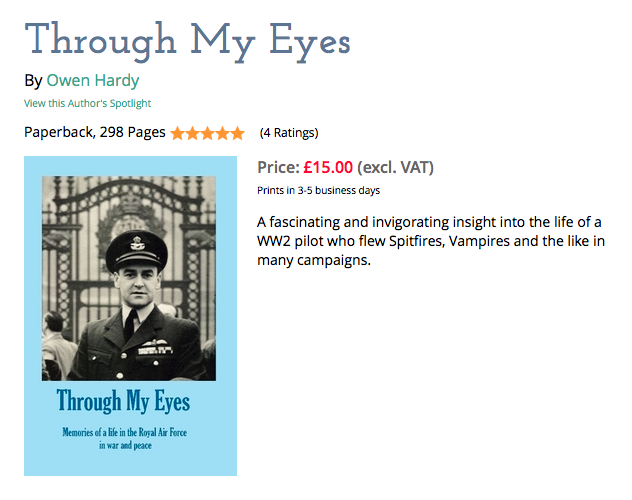
Excerpt from ‘Through My Eyes‘ by Owen Hardy
As one of two Spitfire pilots from his class selected to assist with training the next course as a ‘Staff Pilot’ at Heston (alongside Battle of Britain veterans), Owen would spend six weeks more at the station. The pay-off for this was a guaranteed posting to a frontline Squadron in the South of England, which suited him just fine. He would go on to join 72 Squadron operating out of Biggin Hill. We’d highly recommend purchasing a copy of Owen’s book ‘Through My Eyes’ to read in detail about his extraordinary wartime exploits, and continued aviation adventures thereafter, printed in the US and available through Lulu.com:
After operations in England Owen would go on to active deployments in North Africa, leap-frogging along the coast as Allied Army and Navy units made progress against the enemy. This would take him as far as Tunisia, ultimately to within just 60 miles of Tunis itself.
Isolated from much of the outside world and with limited communication even to their own headquarters he described that they “worked from day to day” doing more or less what they thought was the right thing to do – flying from dawn to dusk. As he put it, they were “up against some fairly good chaps” and by the end operating pretty much off wet mud in the winter – hard living conditions as he described them. But by the latter part of the campaign they’d been armed with Spitfires and were at least able to fight the enemy on equal terms in a suitably capable frontline fighter aircraft.
Owen described the Mk.IX Spitfire as the RAF’s packhorse in 1942-44. With such high demand for the fighter in the European theatre very few Squadrons in the Mediterranean were equipped with them. Owen’s was, and he said it made a tremendous amount of difference – they could carry heavier armament, and had both a longer range and better climb performance that enabled them to more or less compete equally with what the Germans had at the time.
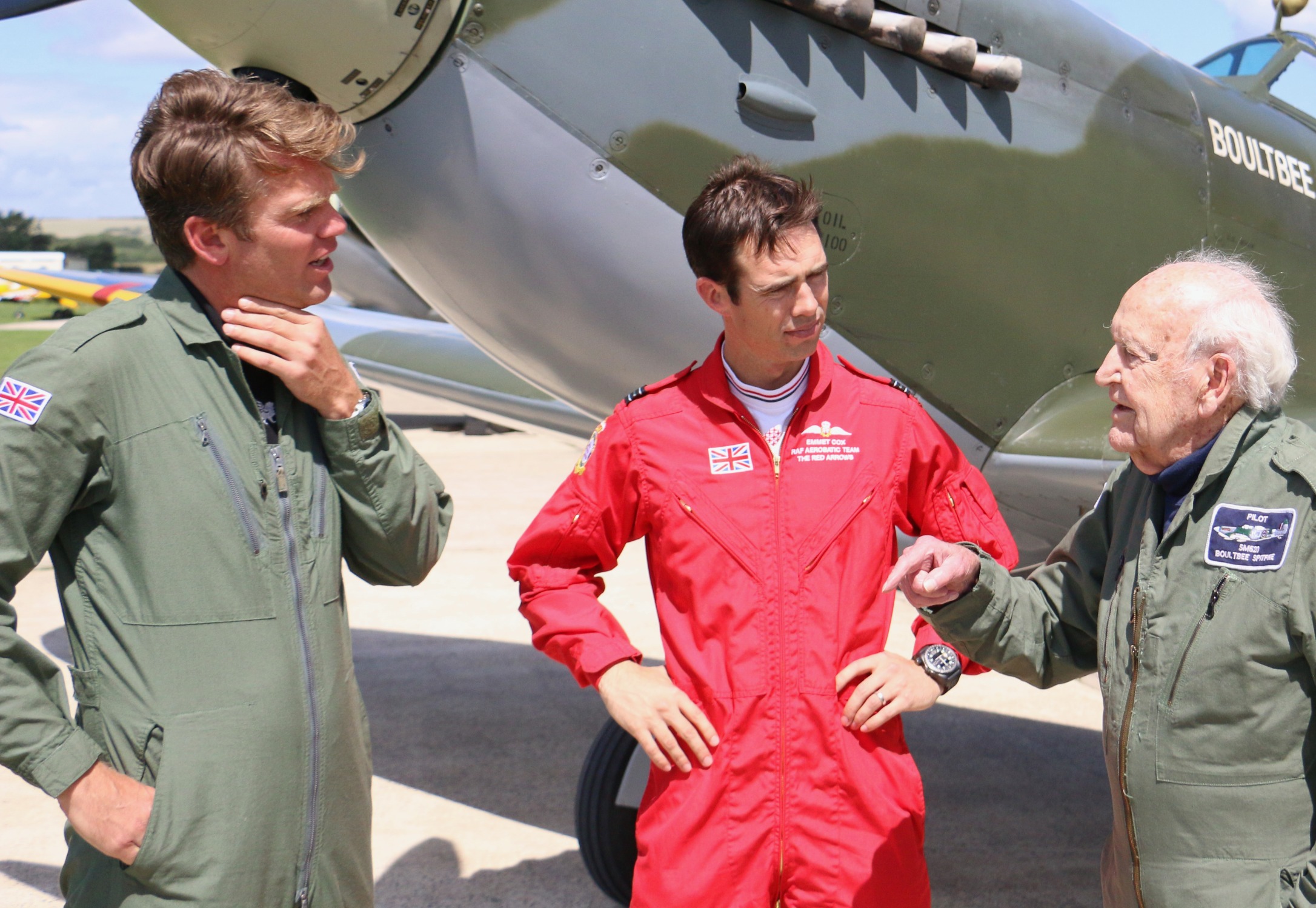
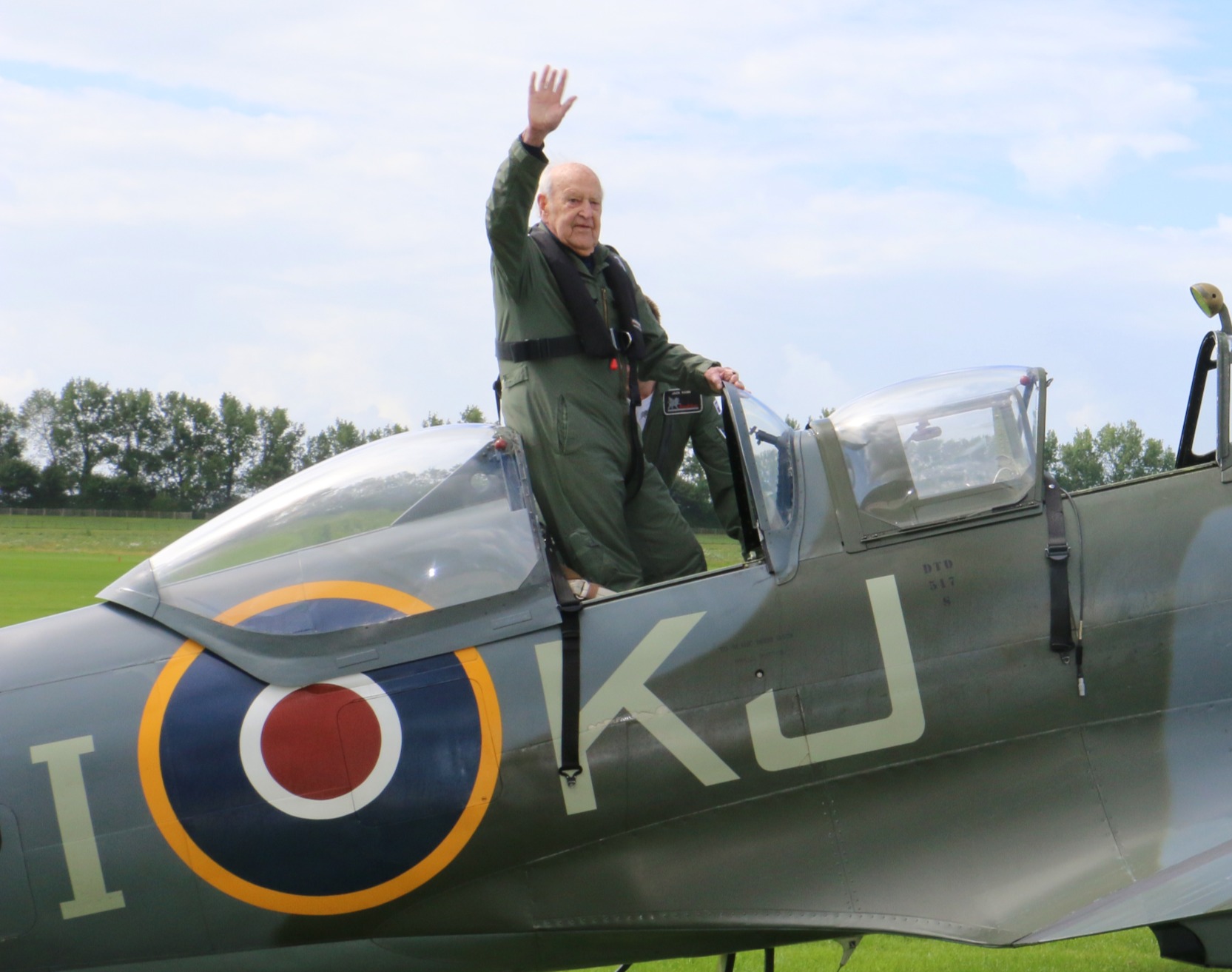
Below you see Owen at the Boultbee Flight Academy in 2017 with (from left) Co-Founder and Managing Director of the Academy Matt Jones (who flew Owen on the day), former RAF Red Arrows pilot Emmet Cox and Operations Manager (and as of last week Spitfire pilot himself!) Tim Granshaw.
As many frontline pilots at the end of the Tunisia campaign Owen was ‘given a rest’ for nine months back in England, undertaking a variety of tasks to contribute to the war effort, not least in training other pilots. But he was hungry for more frontline action and after much pleading ended up in a New Zealand Squadron full of young an inexperienced pilots, but who learned and learned fast. By this stage of the war the action was more air-to-ground in Northern Europe and missions were typically to attack road systems and railways.
Always one to downplay any suggestion that it was great piloting skill that saw him through the war, Owen was adamant that it was basically just luck that saw him survive. He had great admiration in particular not just for other fighter pilots, but those who flew bombers, noting that from his original class those that went to fly with Bomber Command had without exception all gone on to lose their lives before the end of the war. The typical life expectancy of just six months for these men is a statistic as shocking now as it has ever been, and Owen believes they never really got the credit they deserved.
Owen would join the Royal Air Force (RAF) after the war following a brief stint at university that “wasn’t a great success”. He found those years of aircraft development hugely exciting as piston engines made way for the jet age. He would fly Vampires himself to begin with and go on to lead a display team showing off the RAF through the air display circuit around Europe. Before his career was over he would ‘scrabble through’ the sound barrier in both an American F-86 Sabre and a British Hawker Hunter.
His favourite aircraft? Not what you might expect. Owen said that as far as flying goes, for the feel and thrill of flying in and of itself his favourite aircraft was the Tiger Moth, with the rush of the wind in your face from the open cockpit. An appropriately Gentlemanly aircraft from a man who greatly enjoyed the thrill and experience of flying throughout his life, and to whom we all owe a great debt, not that he’d hear a word of it!
Each flight in a Spitfire is a trip of wonder! But today the flight was so much more exhilarating after a gap of 70 years. So many memories…
Owen Hardy, 2017

Comments