Why was the Spitfire not constructed from Timber, as per substantial parts of the Hawker Hurricane?
Early aircraft were constructed using frames, typically of timber or steel tubing, which could then be covered with fabric such as Irish linen or cotton. The fabric made a minor structural contribution in tension but none in compression and was there for aerodynamic reasons only. By considering the structure as a whole and not just the sum of its parts, monocoque construction integrated the skin and frame into a single load-bearing shell with significant improvements to strength and weight.
The Hawker Hurricane continued on with the idea of fabric covered frames on the fuselage as per the previous lineage of Hawker bi-planes from the interwar period, such as the Hawker Hart, Auduax and Demon.
The rear fuselage consisted of a girder-like metal space frame surrounded by wooden formers and longerons to give the required shape. The whole structure was then covered with Irish linen and painted with acetone dope to shrink the linen. Despite the apparent complexity, three Hurricanes could be built with the same man-hours as two Spitfires, and during the first year of the war was consistently produced in larger numbers.
Reginald Mitchell and his team at Supermarine had experience of working with stressed skin monocoque construction and when the Air Ministry called for a monoplane, 8 gun fighter they came up with the type 300 later to become the beauty we all love and know.
The frame of Spitfire was supported by the stressed metal skin (an arrangement known as semi-monocoque). They worked together to make the body of the Spitfire incredibly strong. The metal components were made from alloys of aluminium. This ensured that materials were as light as possible, whilst still providing strength and durability.
Under the skin, four horizontal spars of metal called longerons are connected together by a series of oval frames. These frames reduce in size towards the tail and have round holes cut into them. These holes make them even lighter without weakening them.
So is there any wood at all in a Spitfire?
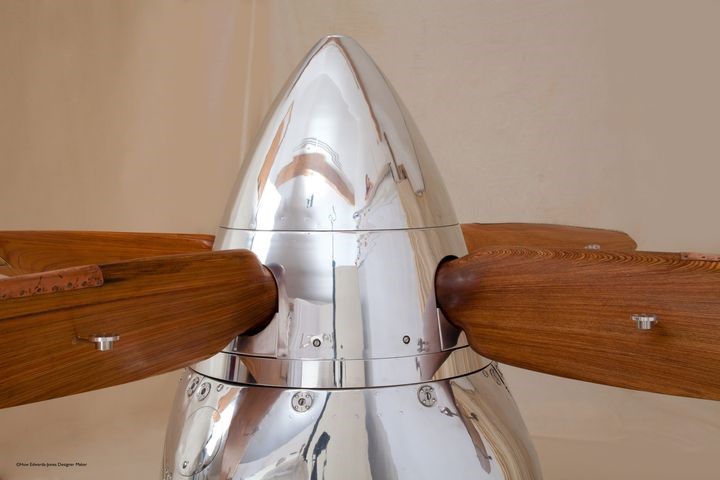
The early Mk1 Spitfires had a wooden two blade fixed pitch prop which is like driving around in first gear in a car. Soon a metal three blade, variable pitch prop was added to enable better use of the power by altering the blade angle. This type was the De Havilland three-blade metal, two-pitch propeller which significantly enhanced the performance of the Mk1 Spitfire. The first constant speed propellers were manufactured by Rotol and these had magnesium alloy blades,
Wood makes a comeback
Hydulignum, a high strength compressed birchwood laminate was the main wooden material used. Rotol bought in the compressed wooden blade blanks and machined them into propellers. This saved valuable metal for the war effort and had the advantage that a wooden propeller that struck the ground transmitted less shock load to the engine than metal.
At the root of the blade, the birch laminate gave way to mahogany and this construction method continues to this day including the four and five-bladed propellers fitted to Spitfires from the MkVIII to Mk24
Wing tips
The wingtips themselves were of wooden construction, spruce formers with the outer aluminium skin screwed to the wood. They could be detached and replaced with a fairing to increase the roll rate of the Spitfire. This offers a major advantage in air-to-air fighting.
Other Parts of the Plane
The wooden rudder was introduced 27-7-40, followed by a brief experiment with wooden elevators 3-11-40, with production fot he rudder returning back to metal for planes produced 20-11-40 onwards.
For the tailplane, production included spruce members on the ribs and use of wood screws up to the production of the Mk V.

Comments