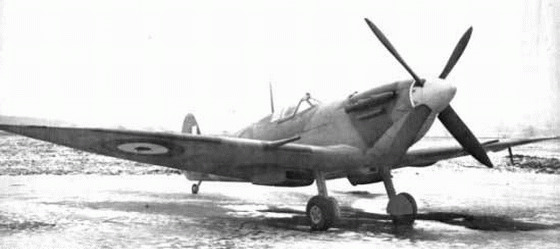
Supermarine Spitfire HF Mk VI
Arrival at Westhampnett
In October 1942, two RAF squadrons moved into RAF Westhampnett (now the Goodwood Aerodrome, home of Spitfires.com) with one of the rarest Spitfire variants of the war — the Spitfire HF Mk VI.
This was no ordinary Spitfire. With its long, extended wingtips and pressurised cockpit, it looked somewhat ungainly next to the sleeker Mk V and Mk IX. The squadrons that received the type were 616 (South Yorkshire) Squadron, carrying aircraft codes YO, and 124 (Baroda) Squadron, coded ON.
Why the Spitfire HF Mk VI was needed
By early 1941, British intelligence grew concerned about German high-altitude aircraft — notably the Junkers Ju 86 — operating beyond the reach of conventional fighters. Even the Spitfire Mk V, despite its stellar performance, struggled above 37,000 feet due to both engine power loss and pilot physiology at extreme heights.
To counter the potential threat, engineers designed a pressurised, high-altitude Spitfire capable of intercepting enemy bombers and reconnaissance aircraft. The result was the Spitfire HF Mk VI, a purpose-built fighter developed under a new Air Ministry specification for high-altitude interception.
Key features and design changes
Rolls-Royce Merlin 47 engine
At the heart of the Mk VI was the Rolls-Royce Merlin 47, producing about 1,415 hp. This high-altitude engine gave the aircraft the ability to climb to 40,000 feet, extending the Spitfire’s operational ceiling beyond anything achieved before.
Extended wingtips for high-altitude lift
The most visible difference was its extended pointed wingtips, which increased the wingspan from 36 ft 10 in to approximately 40 ft 2 in. These “tip extensions” provided better lift in thin air — a defining feature of this high-altitude Spitfire design.
Pressurised cockpit design
To help pilots cope with the reduced oxygen levels at altitude, the HF Mk VI featured a pressurised cockpit. This early system required a fixed, non-sliding canopy, bolted and sealed before flight to maintain pressure integrity. Though it could be jettisoned in an emergency, many pilots found it restrictive and disliked its limited visibility.
Four-bladed Rotol propeller
A larger four-bladed Rotol propeller made better use of the Merlin’s power in thinner air, improving climb rate and stability — essential qualities for high-altitude interception missions.
Spitfire HF Mk VI performance and specifications
Around 100 aircraft were produced between December 1941 and October 1942. Key figures include:
Maximum speed: ~364 mph (586 km/h) at 22,000 ft
Service ceiling: ~40,000 ft (12,175 m)
Armament: 2 × 20 mm Hispano II cannon + 4 × 7.7 mm (.303 in) Browning machine guns
Engine: Merlin 47, 1,415 hp
Loaded weight: ~3,000 kg due to pressurisation and structural reinforcements
This performance placed the HF Mk VI among the highest-flying piston-engine aircraft of its day, but it came at a cost in handling and practicality.
Operational use and shortcomings
Though designed with ambition, the Spitfire HF Mk VI proved limited in service.
The pressurised cockpit was unpopular — the bolted canopy reduced visibility, comfort, and pilot confidence, especially during emergencies. Even after modifications, the escape system remained awkward to operate.
In Britain, its high-altitude capability was impressive on paper, but in other theatres such as the Middle East, tropicalised Spitfire Mk Vs often outperformed it due to lighter weight and simpler systems.
Crucially, the anticipated high-altitude bomber threat never fully materialised. As a result, the HF Mk VI’s specialised design became unnecessary. Many were reassigned to training and support roles, and their extended wingtips and pressurisation systems were often removed for simplicity.
Legacy and significance of the HF Mk VI
Although the HF Mk VI never became a frontline legend, it was an essential evolutionary step in Spitfire development. Lessons from its shortcomings informed future high-altitude Spitfires, particularly the Mk VII, which introduced a more reliable pressurised cockpit and a two-stage supercharged Merlin engine for sustained performance at 40,000 feet.
The Mk VI also highlighted the limits of over-specialisation: added weight and complexity often delivered marginal gains when the predicted threat never came. Yet its experiments in pressurisation and canopy design contributed directly to later aircraft engineering.
Anecdotes and operational notes
First deliveries: Entered service in April 1942 with No. 616 Squadron at RAF Kings Cliffe, later moving to RAF Westhampnett in October
Combat success: On 25 May 1942, a Dornier Do 217 became one of the first recorded victories for a Spitfire Mk VI
Pilot impressions: Many found the fixed, pressurised canopy claustrophobic and difficult during fast climbs or dives, making frequent altitude changes challenging
Despite these frustrations, the aircraft marked a bold attempt to extend the Spitfire’s reach into the stratosphere.
The legacy of high-altitude Spitfires
The Spitfire HF Mk VI may not stand among the most celebrated variants, but it represented a bold leap in design ambition. It emerged from a moment when engineers sought to push the limits of piston-engine flight, anticipating future threats that fortunately never came.
As part of the Spitfire’s broader evolution — from low-level dogfighters to high-altitude interceptors — the Mk VI helped shape what came next. Its influence lived on in later marks, ensuring that every new Spitfire could climb higher, fly faster, and give its pilot a better chance to fight and survive.

Comments