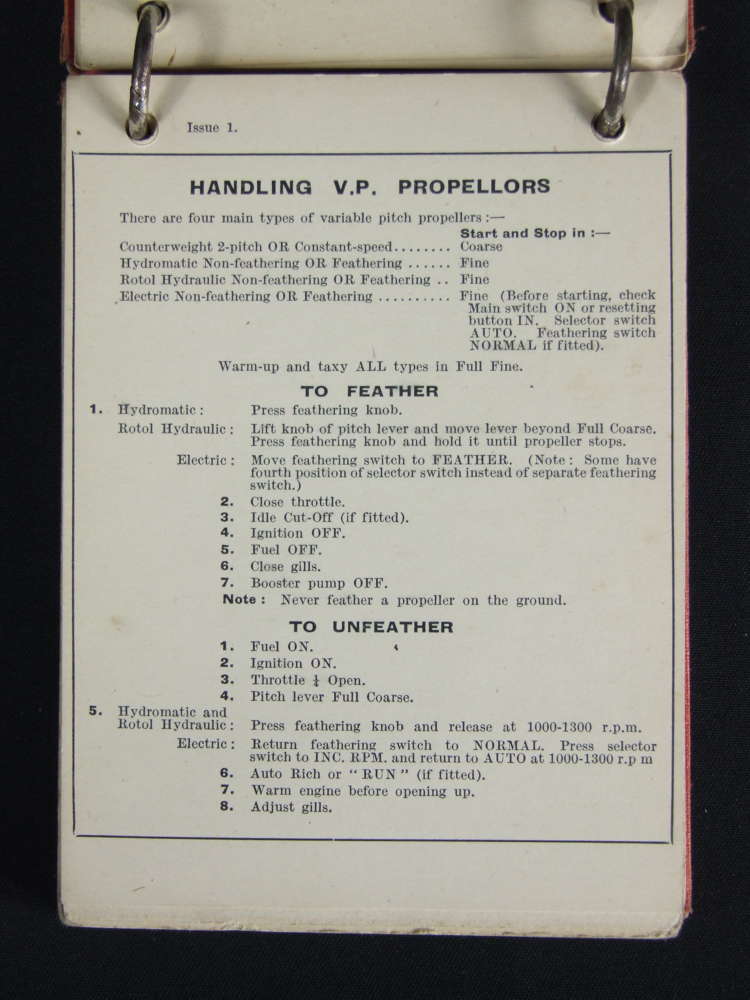
Feathering instructions in ATA Pilot’s Notes
What Was the Air Transport Auxiliary?
The Air Transport Auxiliary (ATA) was formed in 1939, just before the outbreak of
World War II, to ferry aircraft between factories, maintenance units, and front-line
airfields across Britain.
While the RAF’s combat pilots were engaged in battle, the ATA took over the critical
but dangerous task of delivering new, repaired, and damaged aircraft wherever they
were needed. This freed up military pilots for combat missions.
ATA pilots flew:
Fighters like the Spitfire, Hurricane, and Tempest
Bombers such as the Lancaster, Wellington, and Mosquito
Trainers, transports, and flying boats
In total, they delivered over 309,000 aircraft of 147 different types — a staggering
achievement under wartime conditions.
The Pilots Behind the ATA
ATA pilots came from diverse backgrounds — airline pilots, flying club enthusiasts,
farmers, teachers, and even racing drivers. Many were international volunteers from
the U.S., Canada, Poland, New Zealand, and South Africa.
Perhaps most remarkably, the ATA became one of the first organizations in history to
employ women pilots on equal pay to men — a groundbreaking decision in 1943.
Women such as Pauline Gower, Amy Johnson, Diana Barnato Walker, and Maureen
Dunlop became aviation icons, proving that skill, not gender, determined a pilot’s
worth. One of the Women aviators who had flown with the ATA, flew with us at
Spitfires.com. Her name was Mary Ellis who delivered 14 different Spitfires into our
home airfield of Goodwood during 1944/45. She was based at Hamble and ferried
over 1000 aircraft to different airfields, racking up 76 different aircraft types including
heavy bombers as well as the Spitfire.
Flying Without Radios — The Role of Pilot’s Notes
ATA pilots often flew solo, in aircraft they had never flown before, and frequently
without radios or advanced navigational aids.
Each day, a pilot might fly several different aircraft types — from a nimble Spitfire in the morning to a heavy Wellington bomber in the afternoon. So how did they manage
this?
The answer lies in their Pilot’s Notes.
What Were Pilot’s Notes?
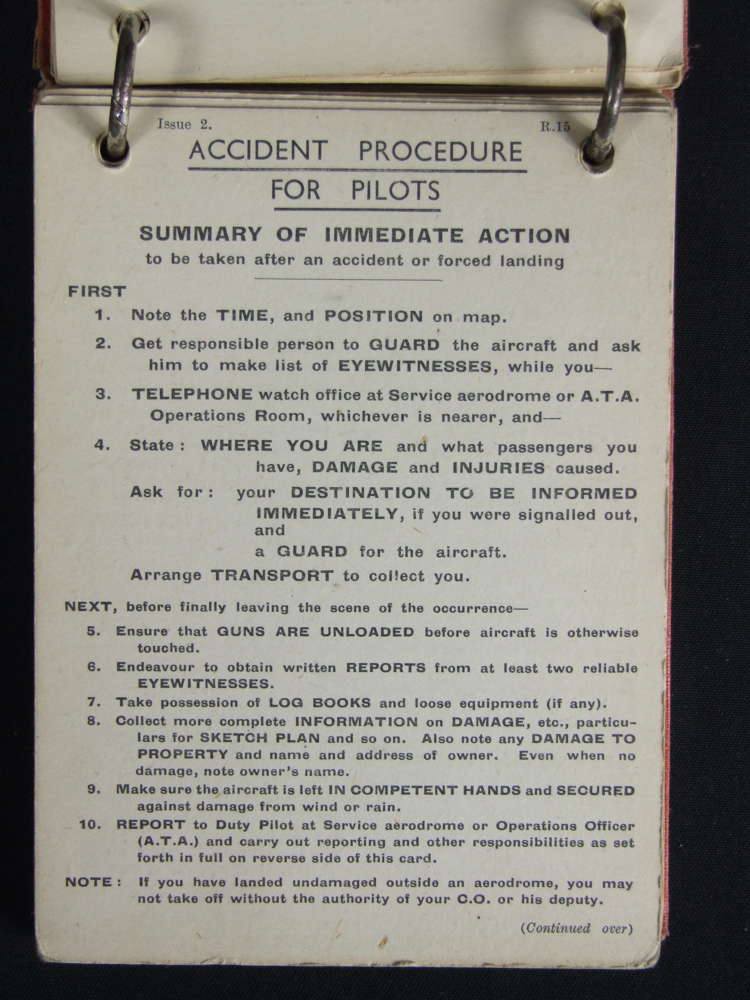
Accident procedure for pilots in ATA Pilot’s Notes
Pilot’s Notes were concise, essential guides that summarized the key information
needed to operate each aircraft safely.
Unlike full operating manuals, which could be dozens of pages long, the ATA Pilot’s
Notes distilled everything a pilot needed to know into just one or two pages,
including:
Engine start-up procedures
Take-off and landing speeds
Fuel and oil system operation
Undercarriage and flap controls
Emergency procedures
Trim and power settings
Since there was no time for lengthy briefings or training on every type, these notes
were literally lifesavers.
ATA pilots carried a small, well-worn folder — sometimes called the “Ferry Pilot’s
Bible” — containing hundreds of such notes for the wide variety of aircraft they could
be assigned to fly.
A Day in the Life of an ATA Pilot
Imagine being handed a sealed envelope early in the morning. Inside: your
destination, the aircraft type, and its location.
You might catch a train to an aircraft factory, climb into a brand-new Spitfire you’ve
never flown, check the Pilot’s Notes, and take off. After delivering it to an RAF base,
you’d grab another set of notes for a different aircraft — perhaps a twin-engine
Oxford — and continue your journey.
Every flight was a test of adaptability, airmanship, and nerves. ATA pilots flew in poor
weather, without armament or instruments, and often under the threat of enemy
aircraft.
The Legacy of the ATA
By the end of the war, the ATA had proven itself indispensable.
It ferried:
309,011 aircraft
Over 120 million miles flown
At a cost of 173 lives lost in service
The ATA disbanded in 1945, but its influence lived on. It demonstrated the value of
civilian aviation in wartime logistics and helped pave the way for the post-war
inclusion of women in professional aviation roles.
Conclusion
The Air Transport Auxiliary may not have fought dogfights over the Channel, but its
pilots were every bit as brave. Armed with nothing more than their skill, courage, and
a few pages of Pilot’s Notes, they ensured that Britain’s fighting squadrons were
always supplied with the aircraft they needed.
Their story is one of quiet heroism — of ordinary men and women who, through
sheer determination, kept the engines of freedom running.

Comments